
 WRITTEN BY
Fahmeena Begum
Technology, Business & Digital Trends Writer
WRITTEN BY
Fahmeena Begum
Technology, Business & Digital Trends Writer
Fahmeena creates clear and practical content across technology, business, digital marketing and emerging digital trends.
View Author Profile → REVIEWED BY
Sameena Begum
Digital Content Reviewer
REVIEWED BY
Sameena Begum
Digital Content Reviewer
Sameena reviews selected All Reddit content for clarity, consistency, factual presentation and reader usefulness.
View Reviewer Profile →Impulse buying is a powerful and widespread consumer behavior in the United States, influencing billions of dollars in retail sales each year. Whether it’s grabbing a snack at a checkout counter or clicking “Buy Now” during an online flash sale, these unplanned purchases follow a predictable psychological journey known as the impulse purchase cycle.
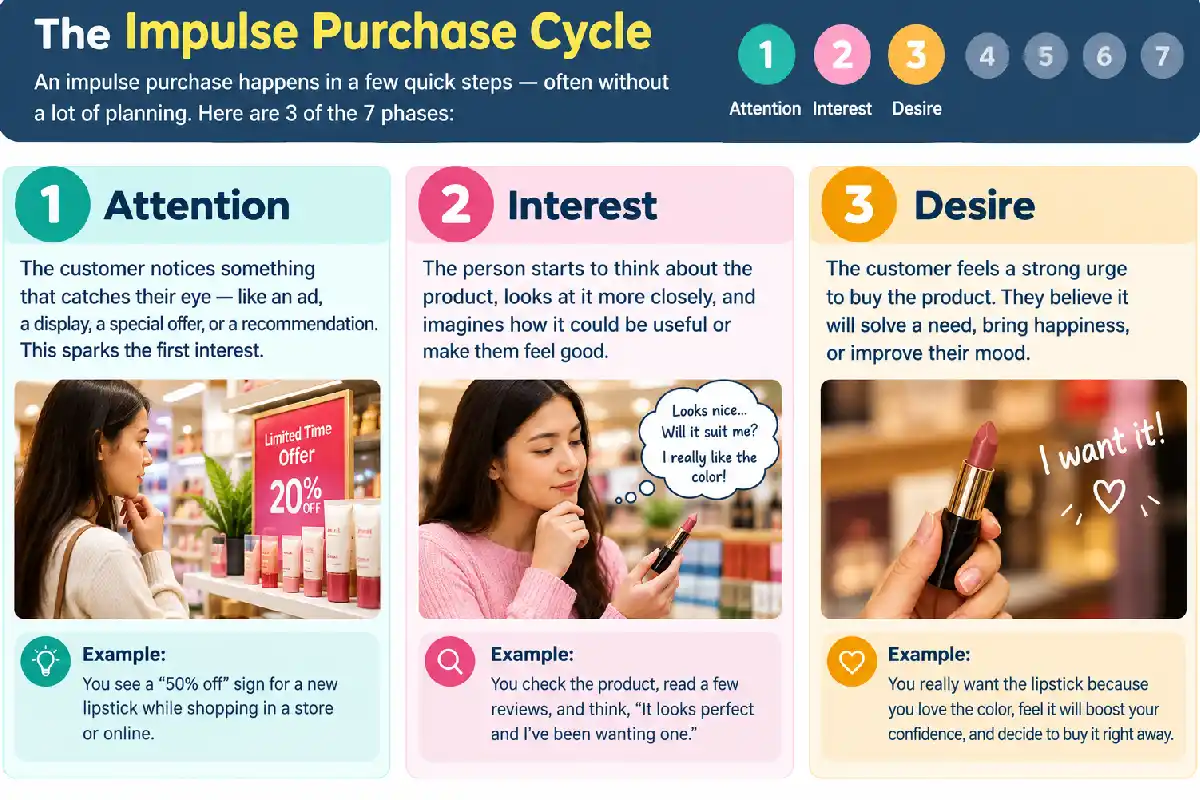
In marketing and consumer psychology, researchers often describe seven phases in this cycle—from initial exposure to post-purchase reflection. However, to understand the core mechanism, it is essential to focus on three of the most influential phases:
- Trigger (Awareness)
- Emotional Justification (Decision Formation)
- Purchase (Action Phase)
These phases are especially relevant in the U.S., where advanced retail strategies, digital marketing, and consumer culture amplify impulse buying behaviors.
Table of Contents
Understanding Impulse Buying in the United States
Impulse buying refers to a spontaneous, unplanned decision to purchase a product, typically driven by emotions rather than rational evaluation. According to consumer behavior studies, a large percentage of U.S. shoppers admit to making impulse purchases regularly, often influenced by marketing cues, discounts, and emotional triggers.
Retailers in the U.S.—from supermarkets to e-commerce giants—design their environments to encourage such behavior. Flash sales, limited-time offers, personalized ads, and checkout displays are all engineered to guide consumers through the impulse purchase cycle.
Overview of the Seven Phases of the Impulse Purchase Cycle
Before diving into the three key phases, it’s helpful to understand the full framework:
| Phase | Description | Consumer State |
| Trigger / Awareness | First exposure to product | Curiosity |
| Interest | Attention increases | Engagement |
| Desire | Emotional attachment forms | Want |
| Evaluation | Quick mental assessment | Consideration |
| Decision / Justification | Rationalizing purchase | Approval |
| Purchase | Buying action | Satisfaction |
| Post-Purchase | Reflection or regret | Evaluation |
What is the Trigger Phase?
The trigger phase is the starting point of the impulse purchase cycle. It occurs when a consumer encounters a stimulus that sparks an unplanned desire to buy.
This stimulus can be:
- External (advertisements, store displays, discounts)
- Internal (emotions like boredom, stress, or excitement)
In the U.S., triggers are often highly sophisticated due to advanced marketing technologies such as AI-driven recommendations and targeted advertising.
Key Characteristics
- Immediate attention capture
- Emotional reaction
- Minimal logical thinking
According to research, triggers “bypass logical thinking and appeal directly to emotion,” making them highly effective in initiating impulse buying.
Promotional emails featuring personalized product recommendations, discount codes, and limited-time deals can encourage consumers to make unplanned purchases. Businesses can use email marketing to communicate relevant offers and maintain engagement with potential customers.
Common Trigger Examples in the U.S.
| Trigger Type | Example | Impact on Consumer |
| Visual | “50% OFF” signs | Creates urgency |
| Digital | Social media ads | Personalized appeal |
| Sensory | Smell of food in stores | Emotional craving |
| Social | Influencer recommendations | Desire to fit in |
| Psychological | Fear of missing out (FOMO) | Immediate action urge |
Why Triggers Are So Powerful
In the U.S. retail environment, triggers are carefully engineered. For example:
- Checkout aisle placement exploits decision fatigue
- Limited-time offers create urgency
- One-click purchasing reduces friction
These strategies reduce the time between desire and action, making impulse purchases more likely.
What is Emotional Justification?
Once the trigger sparks interest, the consumer enters the emotional justification phase. This is where the brain rationalizes the purchase, transforming a “want” into a perceived “need.”
This phase blends emotion with logic, creating a mental narrative that justifies the purchase.
Examples of Internal Dialogue
- “I deserve this after a long week.”
- “It’s on sale—I’d save money by buying it.”
- “This will improve my lifestyle.”
As studies show, this phase is about comfort rather than practicality, reinforcing the decision emotionally.
Search visibility also plays an important role in helping consumers discover products while researching their needs. Applying effective SEO strategies can improve a business’s visibility in search results and attract relevant visitors to its website.
Psychological Mechanisms Behind Justification
| Mechanism | Explanation | Example |
| Self-reward | Treating oneself | Buying luxury items |
| Scarcity bias | Fear of missing out | Limited-time deals |
| Social proof | Following others | Trending products |
| Cost-per-use logic | Minimizing guilt | “I’ll use it often” |
| Emotional relief | Stress reduction | Shopping therapy |
Role of Marketing in the U.S.
Social platforms can encourage unplanned purchases through influencer recommendations, targeted advertisements, product demonstrations, and limited-time offers. Effective marketing strategies in social media help brands capture attention and influence consumer purchasing decisions.
American marketers actively target this phase by:
- Highlighting discounts (“Save $100 today!”)
- Using testimonials and reviews
- Creating urgency with countdown timers
- Personalizing offers based on browsing history
These tactics reinforce the consumer’s internal justification, making the purchase feel logical.
What Happens in the Purchase Phase?
The purchase phase is the moment when the consumer acts—completing the transaction either online or in-store.
This phase is characterized by:
- Speed
- Minimal deliberation
- Emotional satisfaction
Once the justification is complete, the transition to purchase is often immediate.
Why the Purchase Phase Feels Rewarding
Understanding consumer preferences helps businesses develop more relevant promotions and product messages. The strategic STP marketing process, which involves segmentation, targeting, and positioning, enables marketers to reach suitable audiences with offers that match their interests.
When consumers make a purchase, the brain releases dopamine, a neurotransmitter associated with pleasure and reward. This creates a sense of excitement and satisfaction.
As noted in research, impulse purchases are:
- Fast
- Emotion-driven
- Highly satisfying in the moment
Purchase Behavior in the U.S.
| Channel | Example | Key Feature |
| Online | Amazon “Buy Now” | One-click checkout |
| Mobile | App purchases | Instant transactions |
| In-store | Checkout impulse items | Convenience |
| Social commerce | Instagram shopping | Direct purchase links |
Risks of the Purchase Phase
While satisfying, this phase can lead to:
- Overspending
- Buyer’s remorse
- Accumulation of unused products
In the U.S., where credit access is widespread, impulse purchases can also contribute to debt accumulation.
Integrated View: How the Three Phases Work Together
Traditional advertising can also trigger impulse purchases by attracting attention through newspapers, magazines, brochures, and posters. Exploring different print media examples helps businesses understand how offline promotions can influence consumer awareness and buying decisions.
| Phase | Role in Cycle | Emotional Intensity | Time Duration |
| Trigger | Starts the process | Medium | Seconds |
| Justification | Reinforces decision | High | Minutes |
| Purchase | Completes action | Peak | Instant |
These phases form a rapid psychological loop, often occurring within minutes or even seconds in digital environments.
Real-World Example (U.S)
Imagine a consumer browsing online:
- Trigger: Sees a targeted ad for sneakers on social media
- Justification: Thinks, “I need new shoes anyway, and they’re on sale”
- Purchase: Clicks “Buy Now” and completes checkout
This entire process may take less than five minutes.
Why These Three Phases Matter
Understanding these phases is important for both consumers and businesses:
For Consumers
- Helps control spending
- Encourages mindful shopping
- Reduces financial stress
For Businesses
- Improves marketing strategies
- Increases conversion rates
- Enhances customer experience
Practical Strategies to Manage Impulse Buying
Marketing campaigns can influence consumer behavior by creating awareness, generating interest, and encouraging quick purchasing decisions. Businesses can use eclipse marketing strategies to strengthen their promotional efforts and attract potential customers.
| Strategy | Description | Effectiveness |
| Delay purchases | Wait 24 hours | High |
| Set budgets | Limit spending | High |
| Avoid triggers | Unsubscribe from ads | Medium |
| Use shopping lists | Stick to planned items | High |
| Reflect on needs | Ask “Do I need this?” | High |
External High-Authority Resources
For further reading and credible insights into impulse buying and consumer behavior in the United States:
- Understanding Consumer Behavior (American Marketing Association)
- Explain Three of the Seven Phases of the Impulse Purchase Cycle
Conclusion
The impulse purchase cycle is a structured psychological process that explains why consumers make spontaneous buying decisions. Among the seven phases, Trigger, Emotional Justification, and Purchase are the most critical, forming the core pathway from desire to action.
In the United States, where marketing innovation and consumer accessibility are highly advanced, these phases are intensified through digital platforms, personalized advertising, and seamless payment systems.
By understanding these phases:
- Consumers can make smarter financial decisions
- Businesses can design more effective marketing strategies
Ultimately, recognizing how impulse buying works is the first step toward controlling it—or leveraging it effectively.
Fahmeena Begum is a writer at All Reddit with 3+ years of experience. Her work covers technology, business, digital marketing, software, online platforms and emerging digital trends.
Sameena Begum is a Digital Content Reviewer with 8 years of experience. Her review work focuses on clarity, readability, consistency and useful factual presentation.