


Most business content is fragmented. This article reframes “series on business” as a structured learning system that teaches how businesses actually work—from foundations to execution.
If you are searching for a series on business, the most direct answer is this: business is best learned as a progression, not as isolated topics. A proper business series helps you understand how markets, customers, value, money, and execution connect in the real world.
The problem is that most business content online does not do this. It explains terms, shares tips, or lists strategies without sequence. Beginners feel confused. Intermediate learners feel stuck repeating basics. Professionals rarely gain sharper decision-making skills.
The solution is a progression-based business series that treats business as a system and builds understanding step by step.
Table of Contents
Revenue & Costs: How Money Really Flows
Many beginners misunderstand profit. Revenue alone does not mean success.
| Element | What It Means |
|---|---|
| Revenue | How value is monetized |
| Fixed costs | Exist even without sales |
| Variable costs | Scale with activity |
| Profit | What sustains the business |
Without this understanding, businesses fail due to underpricing, overspending, or scaling too early.
A Structured Business Series (Beginner → Intermediate → Applied)
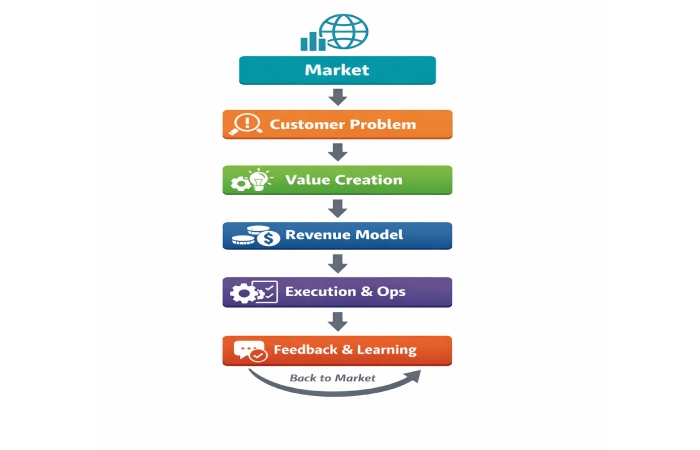
This is where learning becomes effective.
Stage 1 – Business Fundamentals (Beginner)
Goal: Build correct mental models.
Focus on:
-
What a business really is
-
How customers, value, and money connect
-
Why most businesses fail early
Checklist:
-
Can you explain a business in simple terms?
-
Can you trace how money flows from customer to company?
If not, advanced topics will not help yet.
Stage 2 – Functional Integration (Intermediate)
Goal: Understand how parts work together.
Here, marketing, operations, finance, and strategy are learned together, not separately.
For example:
-
Marketing promises value
-
Operations deliver value
-
Finance measures sustainability
Internal link hook: This is where a deeper business models guide fits naturally.
Stage 3 – Operator Thinking (Advanced Application)
Goal: Make decisions under constraints.
This stage focuses on:
-
Trade-offs instead of rules
-
Second-order effects
-
Long-term consequences
Illustrative Example:
Hiring faster may increase output short term but harm quality and culture long term.
Professionals spend most of their careers at this stage.
Types of Business Series (And Who Each Is For)
Not all business series serve the same purpose.
| Type | Best For | Limitation |
|---|---|---|
| Academic | Students | Low practicality |
| Practical | Founders | Context-specific |
| Entrepreneurial | Startups | Higher risk |
| Corporate | Managers | Slower change |
Knowing this helps you choose the right learning approach.
How to Use This Business Series
This series can be used to:
-
Learn business from scratch
-
Teach or mentor others
-
Create structured business content
The key rule: do not skip stages.
Pricing / Cost of Learning Business
| Learning Method | Typical Cost Range | Time Investment | Best For |
|---|---|---|---|
| Free articles & videos | Free | High | Beginners |
| Online business courses | Low–Medium | Medium | Structured learners |
| Certifications / MBAs | High | High | Corporate roles |
| Mentorship / consulting | Medium–High | Medium | Founders |
Tip: Start with low-cost/free methods and layer on structured courses as your understanding grows.
Geographical Context
Core business principles are universal, but legal, regulatory, and cultural factors differ.
-
US: Startups, venture capital, and rapid scaling
-
EU/UK: Strong labor and consumer protections
-
India: Price-sensitive markets, service-driven growth
-
Global online businesses: Fewer location constraints, but taxes and regulations still matter
Common Mistakes When Learning Business
-
Chasing tactics before fundamentals
-
Memorizing frameworks without context
-
Copying success stories without constraints
-
Confusing terminology with understanding
FAQs
Is a series on business enough to start a business?
It builds understanding, not guaranteed success. Execution and testing are still required.
How long does it take to learn business fundamentals?
Weeks to understand concepts. Years to develop judgment.
Is this useful if I don’t want to start a business?
Yes. Business thinking improves careers, management, and decision-making.
What’s the best order to learn business topics?
Market → Value → Money → Execution. Always in that sequence.
How much does it cost to follow a structured business series?
Depends on method: free videos to high-cost MBAs. See the pricing table above for ranges.
Do regulations differ by region?
Yes. US, EU/UK, and India differ in compliance, labor, and tax rules. Principles are universal, but always research local requirements.
Conclusion
Explore business while relaxing and having fun with these series. You are watching a series, and being an entrepreneur is not at odds. And also, If you pay attention, you can learn one or more things about a business thanks to them. And also, The series transmit ideas; although at the time they were reviled as means of learning. If they have been considered informal means to acquire knowledge.
Also read: Beauty of Joseon Sunscreen